Your P1 Incident Just Fired. Your AI Triage Assistant Already Has a Runbook.
AI Triage Assistant analyzes the alert, pulls context from Elasticsearch, and generates a remediation plan — in seconds. Reduce MTTR 50-70%. Every engineer responds like a senior.
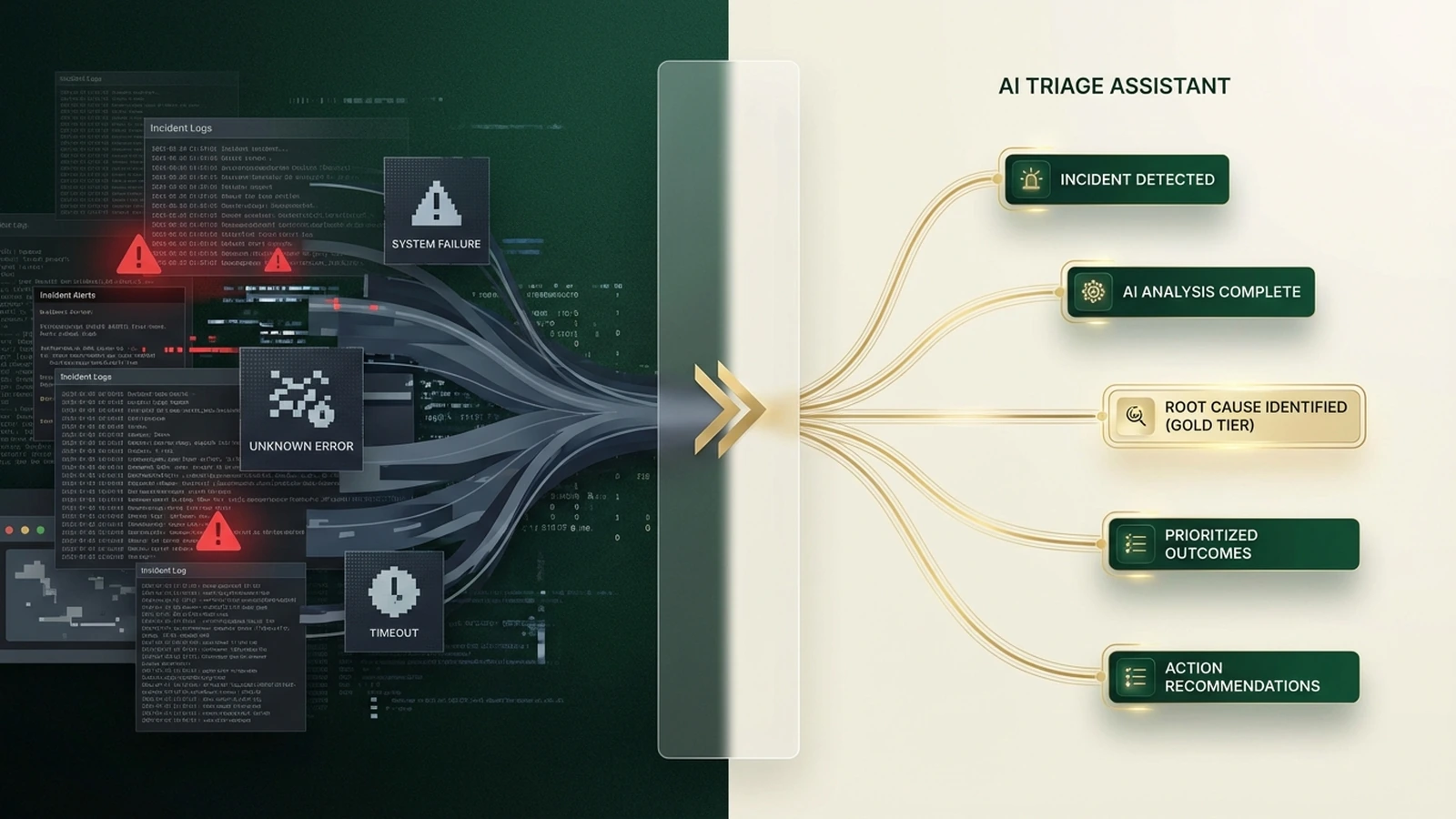
Your Incident Response Is Only as Fast as Your Escalation Chain
Junior Engineers Escalate. MTTR Climbs.
When a P1 fires at 2am, your junior on-call engineer doesn't have the context to act. They escalate to a senior. That escalation adds 30-60 minutes to every incident. Your MTTR is a function of who's on call — not your tooling.
300 Alerts Per Shift. No Context for Any of Them.
Your SOC analysts face hundreds of alerts every shift. Most are noise. The cost of missing one real threat is a breach or a customer-facing outage. More alerts than analysts. The math doesn't work.
Post-Incident Documentation: Manual, Inconsistent, Skipped.
After every incident, someone is supposed to write up what happened. It takes 30 minutes. It's inconsistent. It's usually skipped. Your compliance team has no evidence. Your next on-call has no playbook.
Five Steps from Alert to Resolution
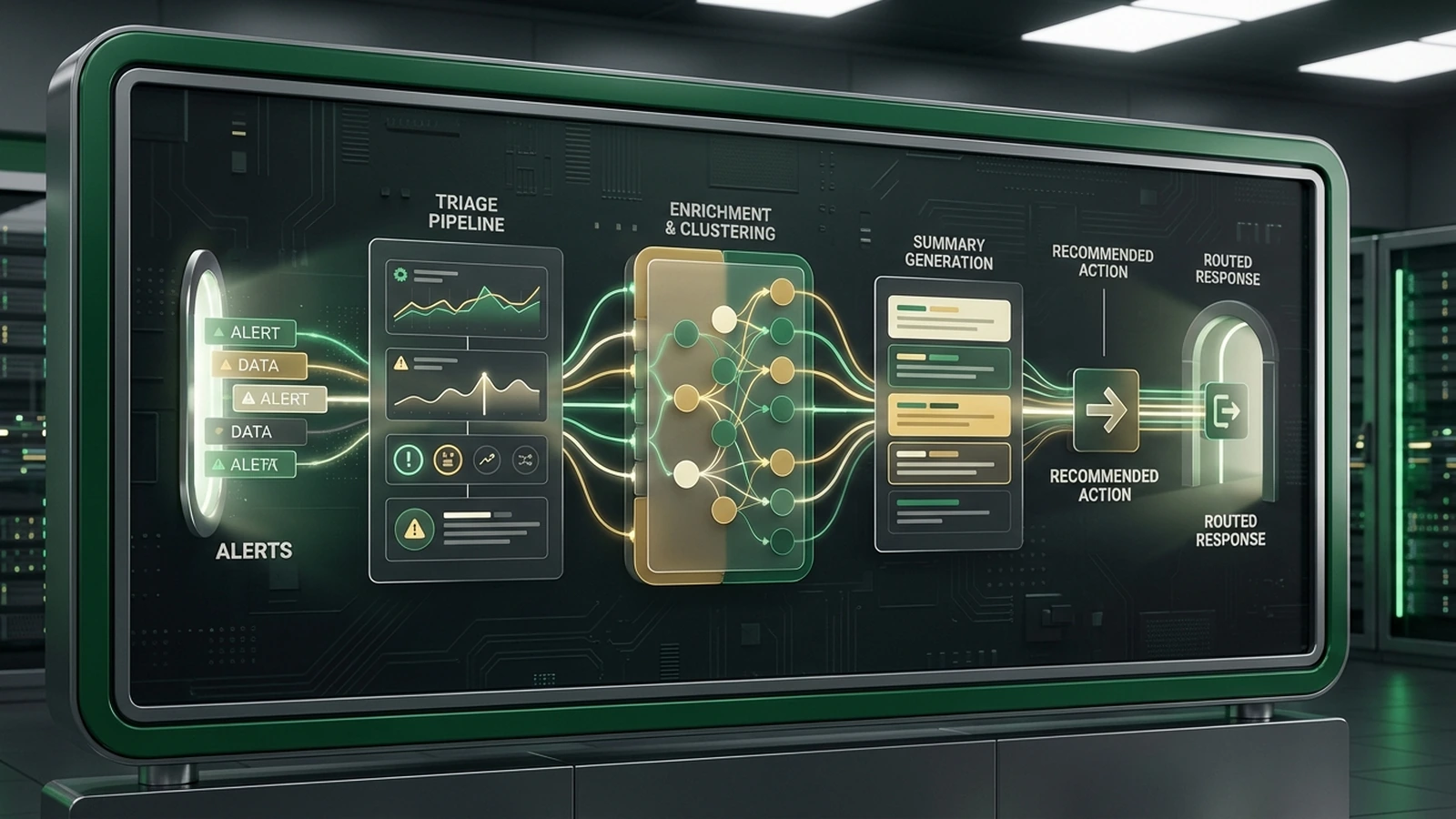
Alert Fires
Incoming alert from Elasticsearch alerting, PagerDuty, Opsgenie, or your SIEM platform triggers AI Triage Assistant.
AI Analyzes
LLM model analyzes alert type, severity, and triggering conditions. Not keyword matching — contextual analysis.
Elasticsearch Context Pull
Queries Elasticsearch indices for correlated data: historical incidents, affected service topology, runbook library.
Triage Report Generated
LLM generates a structured triage report: root cause hypothesis, blast radius estimate, ranked remediation steps.
Ticket Auto-Created
Jira or ServiceNow ticket created automatically with the full triage report. Engineer acts on AI guidance immediately.
What AI Triage Assistant Does
LLM-Powered Root Cause Analysis
AI reads the alert and correlated Elasticsearch context to generate a root cause hypothesis. Not a keyword search. A contextual analysis that considers alert type, historical patterns, and service dependencies.
AI-Generated Remediation Runbooks
Step-by-step remediation instructions generated per incident. Pulled from your historical runbooks and past resolution patterns. Every P1 gets a playbook — written by AI, grounded in your institutional knowledge.
Blast Radius Estimation
Estimates downstream service impact at time of alert. Gives on-call engineers the "how bad is this" answer immediately — before the blast radius expands.
Automated Ticket Creation
Jira, ServiceNow, or PagerDuty ticket created automatically with AI triage report pre-populated. No manual documentation during the incident. Evidence generated as a byproduct.
Multi-LLM Support
OpenAI, Anthropic, Ollama, and self-hosted models. Deploy with your existing AI infrastructure or SquareShift's recommended configuration. No vendor lock-in. Your data stays where you decide.
Closed-Loop Learning
Engineers confirm or correct AI suggestions after resolution. The model improves continuously from production feedback. Your institutional knowledge compounds with every incident.
The Numbers That Matter
Before
P1 fires. On-call engineer checks the alert. Doesn't have context. Escalates to senior engineer. Senior engineer wakes up, opens laptop, gets context. Diagnosis begins. 45 minutes gone before the first remediation step.
After
P1 fires. AI Triage Assistant generates triage report: root cause hypothesis, blast radius, remediation steps. On-call engineer reads the report and acts. Ticket auto-created. 12 minutes from alert to first remediation action.
The AI Intelligence Layer in Your SIEM Stack
AI Triage Assistant works with the SquareShift SIEM accelerator suite — each accelerator strengthens the others.
Only real alerts reach AI Triage. Alarm Noise Suppression eliminates 80-90% of false positives upstream. AI Triage Assistant analyzes signal, not noise.
Threat patterns from the Correlation Engine add context to every triage analysis. AI Triage Assistant sees the threat landscape, not just the individual alert.
Every triage action generates compliance evidence automatically. SOC2, PCI-DSS, HIPAA audit trails are a byproduct of every incident response.
AI Triage Assistant is a primary component of the SIEM Readiness Assessment engagement. Deploy as part of a full SIEM implementation or standalone.
Also applies to AI observability contexts. Triage LLM performance alerts, cost anomalies, and quality degradation incidents from SquareShift Atlas. Same AI triage capability, applied to AI workloads.
Learn more about SquareShift Atlas →Customer Testimonial
Reduced MTTR from 45 minutes to 12 minutes. First-responders get AI-generated runbooks instantly.
AI-Assisted Triage 90% False Positive Reduction — in conjunction with Alarm Noise Suppression
Payments Platform SOC2 case study — audit-ready with AI-generated compliance evidence
Common Questions
Direct answers to what engineering and security teams ask before deploying AI Triage Assistant.
24-hour response to all demo requests.
Your Next P1 Doesn't Have to Start with an Escalation
Schedule a 15-minute demo. See how AI Triage Assistant generates triage reports from your Elasticsearch data — and why teams cut MTTR by 73%.