From 5 Observability Tools to One — in 4 Weeks
Four proprietary accelerators — Alarm Noise Suppression, Log Reduction Engine, Topology Builder, Blast Radius — deployed in your Elasticsearch environment. 80-90% alert noise eliminated. 50-70% storage costs cut. Zero downtime.
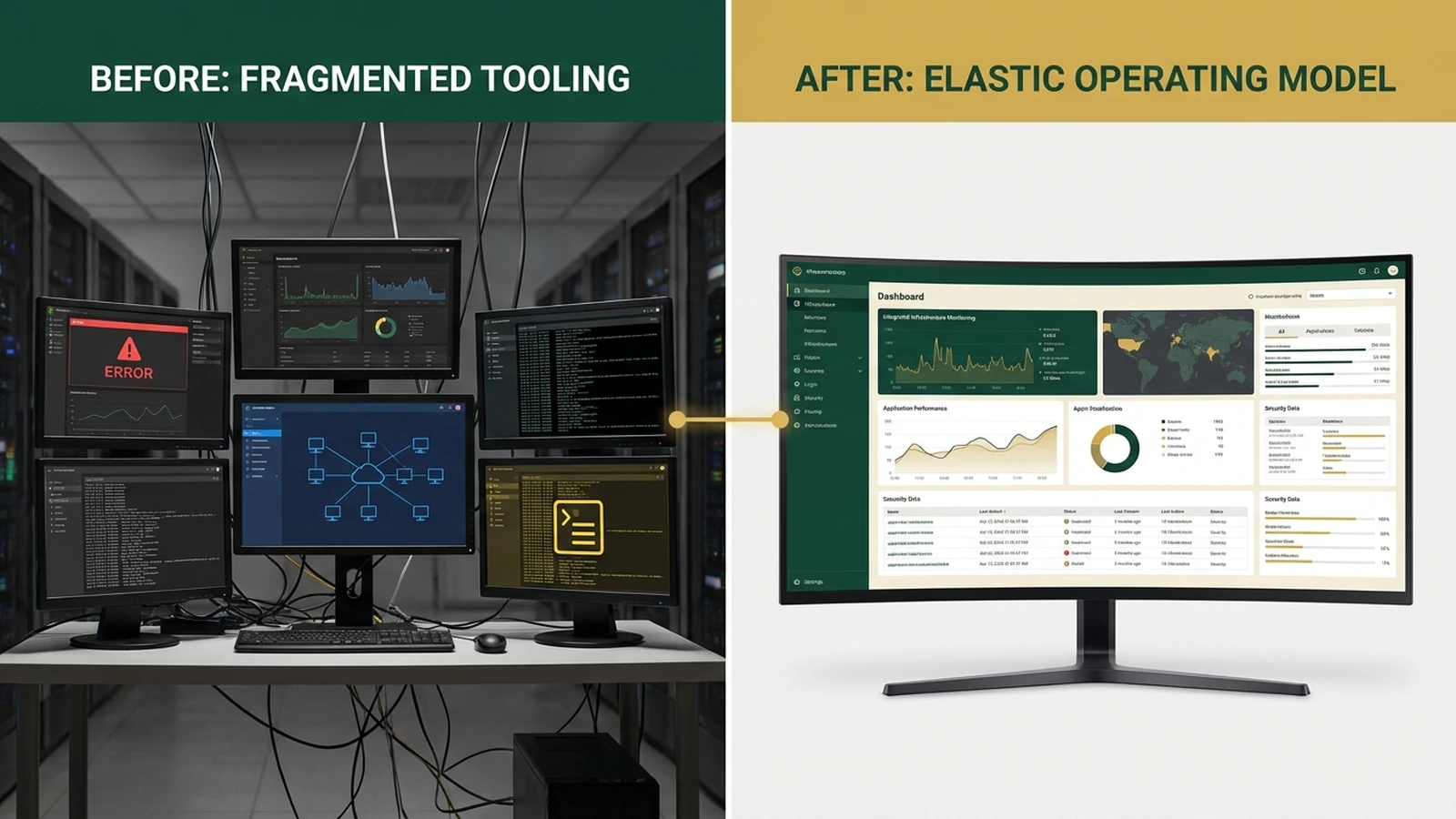
Observability Tool Sprawl Is Costing You More Than Money
Cost Explosion
Data volumes grow 40% per year. Every observability tool charges per GB ingested. Three tools become five. Five contracts multiply. Your observability bill grows faster than your infrastructure — and nobody can explain where the money goes.
Alert Fatigue
500+ alerts per day. 90% are false positives. Your on-call engineers spend more time triaging noise than responding to real incidents. Morale drops. Response time degrades. The alerts that matter get buried in the ones that don't.
Zero Correlated Visibility
Each tool operates in its own silo — logs in one, metrics in another, traces in a third. Correlating a root cause across five tools takes hours. By the time you find the problem, your customers already found it for you.
4 Weeks. One Unified Stack. Measurable Outcomes.
Audit & Architecture
Current-state observability audit: tool inventory, data volume mapping, cost analysis, integration dependencies. Unified Elasticsearch architecture designed and validated with your team.
Core Build
Elasticsearch cluster deployed and configured. Ingestion pipelines built — Beats, Logstash, Elastic Agent, or custom pipelines to match your stack. Data flowing from existing sources into unified platform.
Accelerator Deployment
Alarm Noise Suppression tuned to your alert patterns. Log Reduction Engine configured for your data profiles. Topology Builder activated. Blast Radius analysis configured for pre-deployment risk assessment.
Dashboards, Training, Handoff
Unified Kibana dashboards built: SRE operational view, cost view, alerting view. On-call runbook and alert escalation playbook delivered. Two SRE training sessions completed. Go-live validated.
4 Proprietary Accelerators — Deployed in Your Environment
Alarm Noise Suppression
ML-powered alert correlation that suppresses false positives. Learns your environment's alert patterns. Reduces alert volume 80-90% — not by ignoring alerts, but by identifying which ones are real.
Log Reduction Engine
Intelligent log sampling that cuts Elasticsearch storage costs 50-70%. Eliminates redundant log entries while preserving observability coverage. Your data gets smaller. Your visibility stays the same.
Topology Builder
Auto-generates a live service dependency map from your log and metric signals. No manual documentation. No architecture meetings. Your microservice topology — visible, accurate, and current.
Blast Radius
Pre-deployment change risk analysis. Identifies which services are at risk before you push code. Prevents post-deploy firefighting by showing the blast radius of every change.
Not SaaS. Not drop-ship. Every accelerator is custom-configured to your architecture by our engineers.
Enterprise Observability Consolidation — Verified Results
A global enterprise running four observability tools consolidated into unified Elasticsearch with SquareShift's Observability Modernization Sprint. Alarm Noise Suppression reduced daily alerts from 480 to 47. Log Reduction Engine cut storage costs by 62%. Topology Builder mapped 180+ services in 36 hours. Migration completed with zero downtime. On-call engineer satisfaction scores increased 40% within the first month.
Contact Us for Named ReferencesWhat the Sprint Delivers — and What It Doesn't
The Observability Modernization Sprint is a focused engagement — not a transformation program. It consolidates your primary observability stack into Elasticsearch with four accelerators deployed and configured. Custom integrations with edge-case data sources, compliance-specific configurations (HIPAA, FedRAMP), and multi-region deployment architectures are scoped separately.
We're transparent about boundaries because your time matters. If your scope is larger, we'll tell you before we start — and scope it together.
Need a larger scope? Let's scope it together. →Frequently Asked Questions
Start with a Consolidation Audit
Tell us your current tool stack and data volume. We'll scope the sprint and respond within 24 hours.