500 Alerts a Day. 90% Are Noise. Here's How to Fix That.
Alarm Noise Suppression uses ML to correlate, cluster, and suppress false positives — so your on-call team gets signal, not spam. Documented 90% false positive reduction across 60+ production deployments.
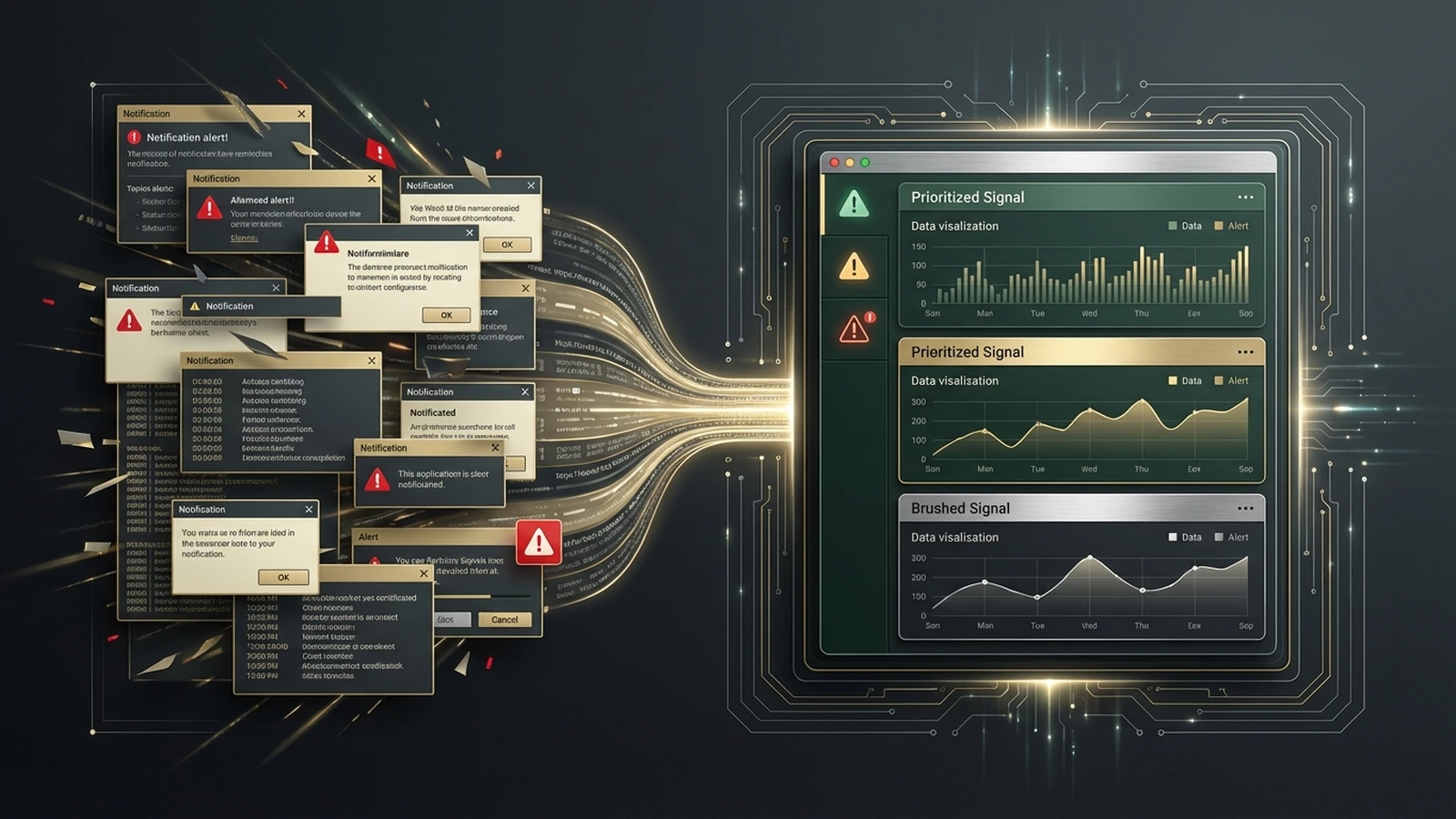
Alert Fatigue Is a Signal Problem, Not a Capacity Problem
500 alerts per day. 90% are false positives. Your on-call team spends three hours daily triaging noise while real incidents get buried. Engineers stop trusting their pager. MTTR climbs. Morale drops.
Real threats get lost in the storm. When a single failure event generates 40 individual alerts, the signal that matters — the actual production incident — never gets seen. Alert noise does not just waste time. It creates risk.
You have tried tuning thresholds manually. It worked for a week. Then the noise came back. Manual threshold tuning is static. The alert stream is not. The problem is statistical, not rule-based — and it requires a statistical solution.
How Alarm Noise Suppression Works
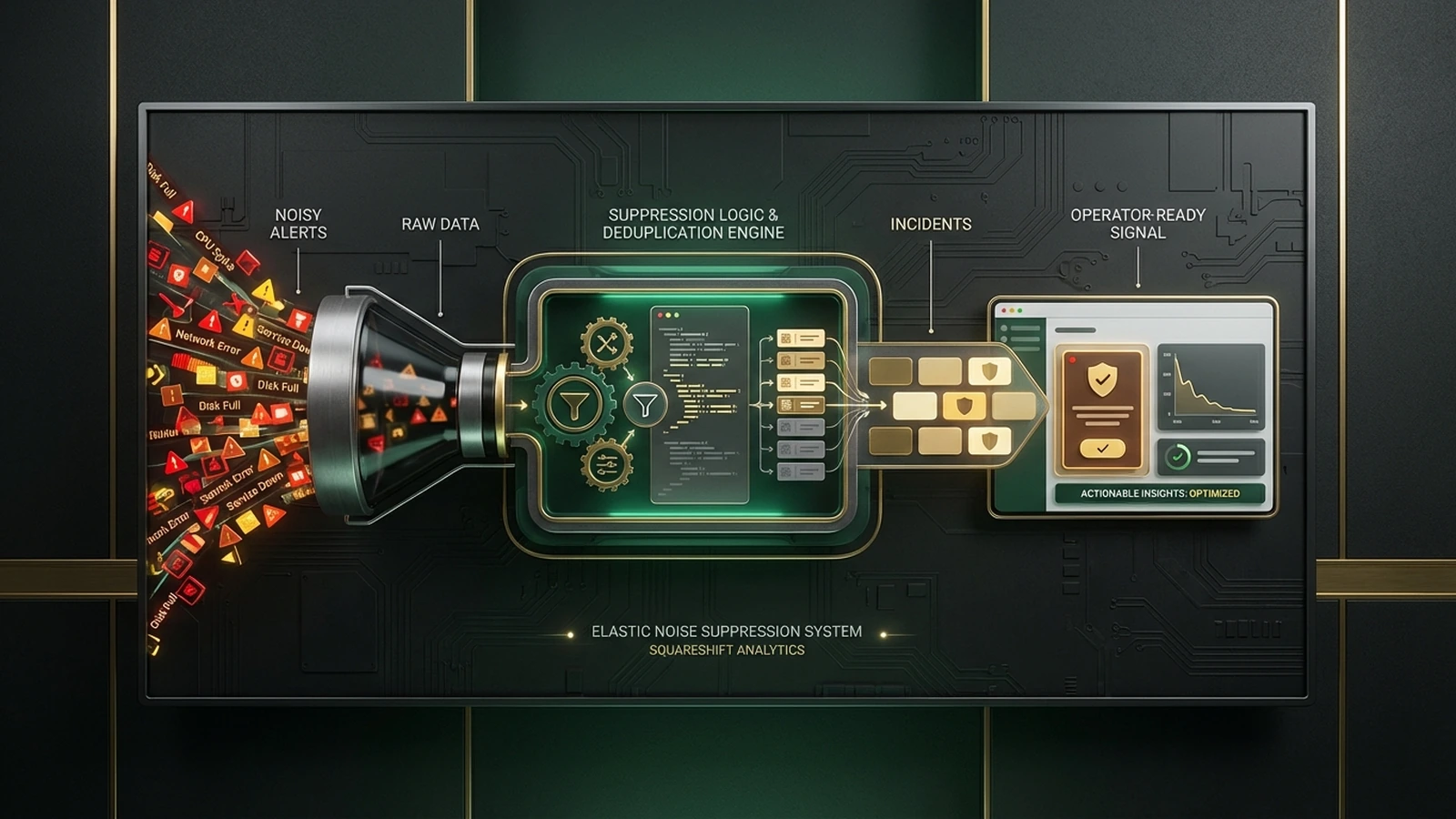
Ingest Your Full Alert Stream
Alarm Noise Suppression connects to your Elasticsearch alerting pipeline and third-party sources.
Elasticsearch connector framework + PagerDuty, Opsgenie, and Slack webhook integration.
ML Learns Your Noise Patterns
The correlation model trains on your historical alert data — identifying which alerts are repetitive, correlated, or false positives.
Trains on historical Elasticsearch indices. Identifies correlated and repetitive alert clusters.
Suppress False Positives. Group Real Incidents.
False positives are suppressed before they reach on-call channels. Related alerts are grouped into unified incident signals.
One page instead of 40 individual alerts per failure event. Suppressed alerts stay in Elasticsearch for audit.
Model Improves Over Time
Adaptive thresholds retrain on production feedback. The model gets more accurate as your environment evolves.
Continuous retraining based on engineer feedback. Human override for "always notify" conditions.
What You Get
ML-Based Alert Correlation
Groups related alerts into unified incidents. When a single failure event triggers 40 alerts, your team gets one incident — not 40 pages. The correlation engine identifies alert clusters that manual rules miss.
80-90% False Positive Suppression
Documented across production deployments. The ML model identifies and suppresses false positives before they reach on-call channels. Your team responds to real incidents, not noise.
Adaptive Thresholds
Self-training suppression sensitivity. The model adjusts based on production feedback — no manual threshold tuning required. The more you use it, the more accurate it gets.
Native Integration with Your On-Call Stack
Alarm Noise Suppression integrates via native connectors with PagerDuty, Opsgenie, and Slack. Your existing on-call routing stays intact. Suppressed alerts remain in Elasticsearch for audit and analysis.
Full Control. Full Audit Trail.
Engineers can mark any suppressed alert as "always notify" for specific conditions. Every suppression decision is logged with a complete audit trail. Compliance-ready from deployment.
On-Call Satisfaction Metrics
Built-in dashboard tracking alert volume reduction, suppression accuracy, and on-call satisfaction scores over time. Prove the impact with data your leadership can see.
The only productized alert noise suppression for Elasticsearch — with documented 90% false positive reduction across 60+ deployments.
Before and After Alarm Noise Suppression
Before Alarm Noise Suppression
After Alarm Noise Suppression
Part of Your Observability Stack
Alarm Noise Suppression is the noise reduction layer in your Elasticsearch observability architecture. It works alongside three other SquareShift accelerators to deliver end-to-end alert intelligence.
Topology Builder
Provides topology context for alert correlation. When Alarm Noise Suppression groups alerts, Topology Builder maps which services are affected and how they connect.
Learn MoreAI Triage Assistant
Takes the alerts that do get through and provides AI-powered remediation suggestions. After noise suppression reduces volume, AI Triage Assistant helps your team resolve faster.
Learn MoreThreat Correlation Engine
Enriches security alerts with ML-based threat detection. For Security teams running SIEM on Elasticsearch, this provides signal enrichment alongside noise reduction.
Learn MorePrimary deliverable in Observability Modernization engagements. Also included in SIEM readiness assessments for security teams.
Customer Proof
“Reduced alert volume from 500/day to 50/day. On-call satisfaction improved 60%.”— SRE Lead, FinTech Company
Common Questions
Stop the Noise. Start the Signal.
Schedule a 15-minute demo. See how Alarm Noise Suppression transforms your alert stream from 500 daily false positives into actionable incident signals.